What Is DTH Hammer Drilling — and When Should You Use It?
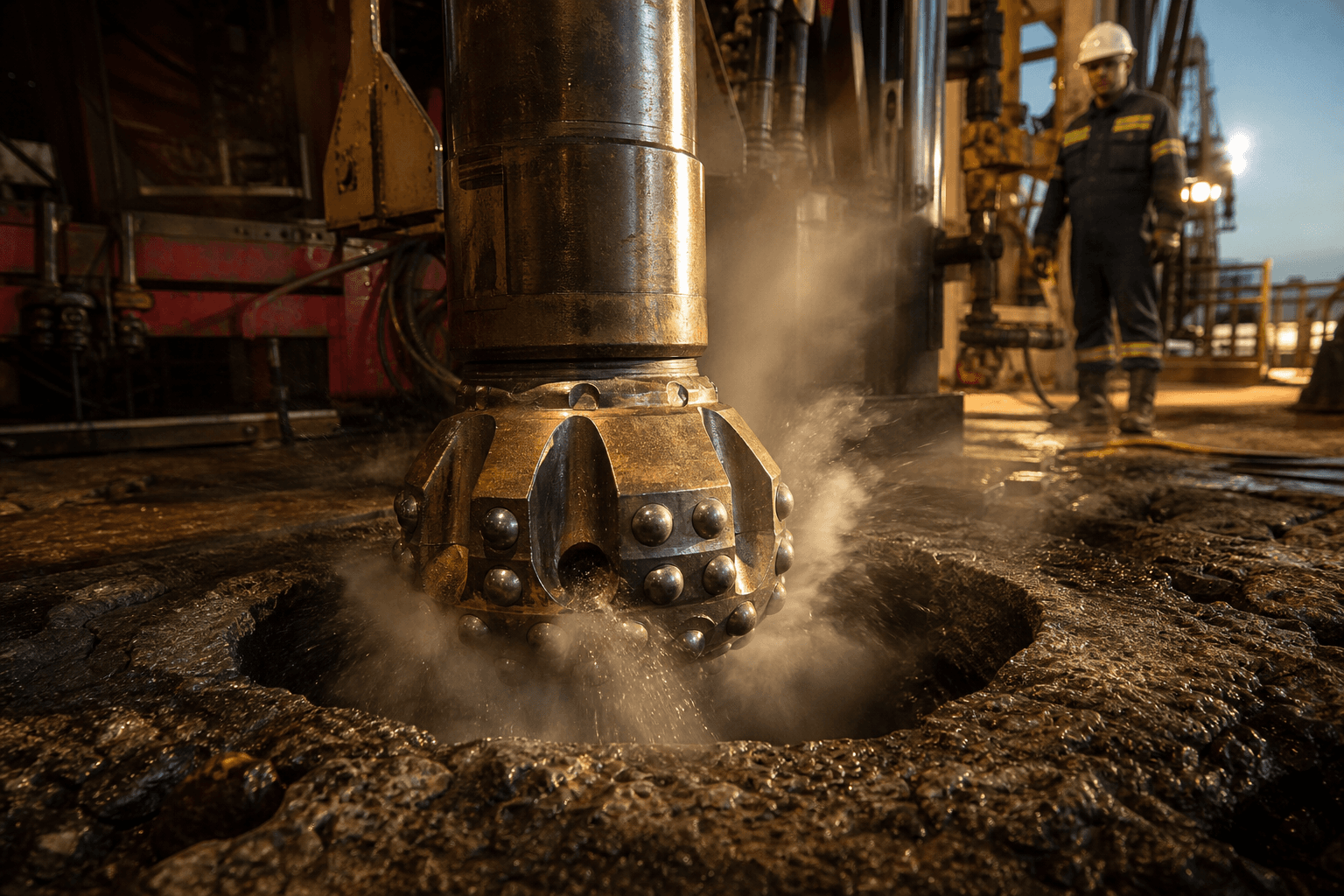
Down-the-hole (DTH) hammer drilling is one of the fastest ways to make hole in hard, abrasive or fractured rock. Instead of relying purely on weight-on-bit and rotation to grind the formation, a DTH hammer uses compressed air to drive a percussive piston that strikes the bit thousands of times per minute — much like a jackhammer working at the bottom of the well.
How the hammer works
Compressed air is sent down the drill string to the hammer, where it cycles a free-moving internal piston up and down. On each downstroke the piston slams into the shank of the button bit, transmitting a sharp impact directly to the rock face. The spent air then exhausts through the bit and sweeps the cuttings back up the annulus to surface. Because the impact energy is delivered right at the bit — not lost down a long string of pipe — penetration rates stay high even as the hole gets deeper.
Where DTH drilling shines
- Hard, abrasive and broken formations where roller-cone or PDC bits wear quickly
- Geothermal and water wells that need straight, fast, large-diameter holes
- Top-hole and surface sections where rate of penetration drives the schedule
- Lost-circulation zones where air or foam is already the chosen circulating medium
What it takes to run one
A DTH hammer is only as good as the air package behind it. The compressors must deliver enough volume to clean the hole, and boosters raise the pressure needed to keep the hammer striking as depth and back-pressure increase. Matching hammer size, bit design, air volume and pressure to the formation is where experience pays off — and it is exactly the kind of spread Hurricane builds and operates in the field.